
Why Most Cold Email Campaigns Fail Before the First Reply

Authored & Posted by
Imon Reza
- How to build a cold email strategy that gets more replies
- Common cold email mistakes that hurt deliverability and trust
- Best practices for personalization, subject lines, and follow-ups
- Tools and workflows to scale cold outreach effectively
- Metrics to track for improving campaign performance over time
Most cold emails fail for one simple reason: they sound cold. They are generic, too long, overly sales-focused, or clearly copied and pasted to hundreds of people at once. Before the prospect even reads the second line, trust is already gone.
A successful cold email strategy is not about sending more emails. It is about sending smarter ones. The best campaigns focus on relevance, timing, personalization, and clear communication. Even small improvements in your subject line, targeting, or follow-up sequence can dramatically increase open and reply rates.
Today, cold email remains one of the most effective ways to generate leads, book meetings, and grow a business. But inboxes are more crowded than ever. If your emails do not feel human and valuable, they get ignored.
In this guide, you will learn how to build a cold email strategy that actually works. From finding the right prospects to writing emails people want to reply to, these practical methods will help you create outreach campaigns that feel natural instead of spammy.
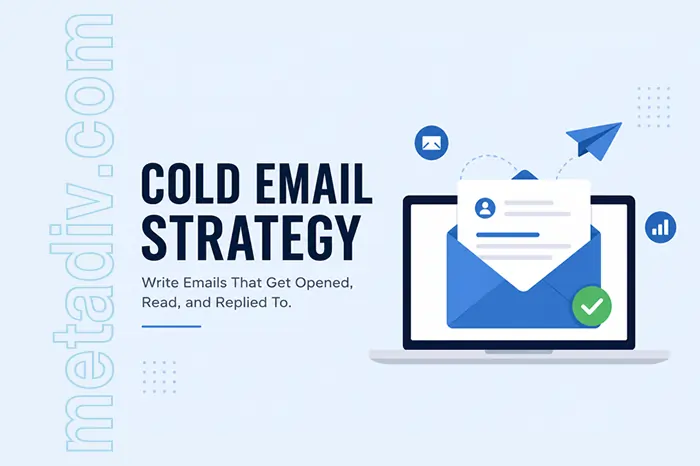
Discover a modern cold email strategy that improves deliverability, personalization, and reply rates. Learn how to write cold emails that feel human, avoid spam folders, and convert more prospects into leads.
Key Points:
- A strong cold email strategy starts with laser-focused prospect research- emailing the right person beats emailing thousands of wrong ones every time.
- Subject lines and opening lines are your two highest-leverage variables; both must create curiosity or relevance within the first three seconds of reading.
- Personalization at scale is possible using simple frameworks (job title + recent trigger + relevant pain)- it doesn’t require writing every email from scratch.
- Every cold email needs a single, low-friction call to action; asking for too much kills conversion before the conversation even starts.
- Systematic follow-up sequences- typically 3 to 5 touches over 10 to 14 days- generate the majority of replies, not the first email.
Why Most Cold Emails Fail Before They’re Even Opened
Every day, inboxes around the world are flooded with cold emails. Most of them get deleted without a second glance. A few get a polite “not interested.” And a very rare few actually start conversations that lead to real business.
The difference between those outcomes isn’t luck. It isn’t industry. It isn’t even the product being sold. It’s strategy.
A cold email strategy is the structured, repeatable system behind every cold outreach effort — the research process, the messaging framework, the sequence design, the follow-up cadence, and the continuous optimization loop that turns a simple email into a revenue channel.
If you’ve ever sent cold emails and heard nothing back, this guide is for you. If you’re just starting out and want to build a process that actually works, this guide is also for you.
By the end, you’ll understand not just what to write, but how to think about cold email as a professional, scalable discipline — not a spray-and-pray guessing game.
What Is a Cold Email Strategy (and Why You Need One)?
A cold email is any email sent to someone who hasn’t previously opted in to hear from you. It could be a sales email, a partnership pitch, a link-building request, a media outreach, or a hiring inquiry.
A cold email strategy, however, is the deliberate system that decides:
- Who receives your emails and why
- What value proposition you lead with
- How you structure the message
- What action you ask for
- When and how often you follow up
- How you measure and improve results
Without a strategy, cold email is just digital noise- annoying, ineffective, and potentially damaging to your domain reputation. With a cold email strategy, it becomes one of the most cost-efficient lead generation and business development tools available to any company or solo operator.
The reason most people skip the strategy step is that it feels slow. They want to send emails today.
But the companies consistently generating 20–40% reply rates on cold outreach are the ones who invested in a framework before they sent a single message.
Step 1: Define Your Ideal Customer Profile (ICP) with Precision
No cold email strategy survives contact with a poorly defined audience. The single biggest mistake in cold outreach is casting too wide a net.
Your Ideal Customer Profile (ICP) is a detailed description of the type of company or person most likely to benefit from what you offer and most likely to say yes. It goes far beyond “B2B SaaS companies” or “marketing managers.”
Recommended Reading:
SEO strategies to Rank your Website and Get Organic Traffic in 2026
A real ICP looks like:
- Company size: 20–150 employees
- Industry: E-commerce, DTC brands
- Revenue range: $2M–$20M ARR
- Technology signals: Running on Shopify, using Klaviyo
- Pain point: High customer acquisition costs, low email revenue
- Decision maker: Head of Growth or CMO
- Geography: US, UK, Australia
The more specific your ICP, the more relevant your outreach can be. And relevance is the engine of cold email.
Remarks
Tools that help with ICP research include LinkedIn Sales Navigator, Apollo.io, Clay, Crunchbase, and BuiltWith for technology signals. Spend time in this step before building your list. The quality of your prospect list is the single greatest predictor of your campaign’s success.
Step 2: Build a High-Quality Prospect List
Once your ICP is defined, you need to build a list of real people who match it. This is not about quantity. A list of 200 hyper-targeted prospects will outperform a list of 2,000 loosely matched contacts almost every time.
When building your list, collect:
- First and last name
- Professional email address (verified)
- Company name and website
- Job title
- One or two personalization data points (recent company news, LinkedIn activity, tech stack, etc.)
The personalization data points are critical — they’re what you’ll use to make your emails feel human and specific, not templated and generic.
For email verification, tools like NeverBounce, Zerobounce, or built-in verification in Apollo can reduce bounce rates dramatically. Sending to invalid addresses damages your sender reputation and reduces deliverability for all future emails.
Remarks
Aim for a bounce rate below 3% before launching any campaign.
Step 3: Nail Your Value Proposition Before You Write a Single Word
The biggest writing mistake in cold email is leading with what you do instead of leading with what the prospect gets.
Your value proposition in a cold email isn’t a product description. It’s a clear, specific statement of outcome. Consider the difference:
Weak:
“We offer AI-powered marketing automation software.”
Strong:
“We help e-commerce brands recover 15–25% of abandoned carts through automated email sequences- without adding to your team.”
The second version speaks directly to a pain (lost revenue from abandonment), offers a concrete outcome (15–25% recovery), and removes an objection (no additional headcount). That’s a value proposition built for cold email.
Before writing your templates, answer these questions:
- What specific problem do you solve?
- What measurable outcome can you deliver?
- How fast or how easily?
- Why should they believe you (social proof, credentials, data)?
Sharpen the answers until they’re specific enough to make a skeptical stranger lean forward.
Step 4: Write Subject Lines That Get Opened
Your subject line has one job: get the email opened. Nothing else matters if the email sits unread.
Great cold email subject lines tend to share a few characteristics:
They’re short.
Aim for 3–7 words. On mobile — where over 60% of emails are read first — long subject lines get cut off.
They create curiosity or relevance.
Either the reader thinks “I wonder what this is” or “this is directly relevant to me.” Either works.
They don’t overpromise.
Clickbait subject lines get opens but kill reply rates because the disconnect between the subject and the email body destroys trust instantly.
They feel human.
Avoid the corporate newsletter energy. “Quick question, [First Name]” still works because it signals a real person, not a broadcast.
High-performing subject line formulas for cold email:
- “[Mutual connection] suggested I reach out”
- “Question about [Company]’s [specific thing]”
- “[Specific outcome] for [Company]?”
- “Idea for [pain point they likely have]”
- “[First Name] — saw your post on [topic]”
Test two to three subject lines per campaign using A/B split testing if your tool allows it. Open rate is your feedback loop for subject line performance.
Step 5: Write a Cold Email Body That Converts
The body of a cold email is where most people over-complicate things. They write paragraphs. They list features. They attach decks. They explain their entire company history.
Don’t do any of that.
A cold email that converts is short, specific, and structured around the reader’s interests — not yours. The proven framework looks like this:
Line 1 — The Personalized Opener
Reference something specific to this person: a piece of content they published, a recent company announcement, their LinkedIn activity, a mutual contact, or a challenge common to their role. This line proves you’re not spamming.
Example: “Saw that [Company] just expanded into the UK market — congrats. International expansion usually brings some interesting challenges around customer onboarding.”
Lines 2–3 — The Value Statement
Briefly state what you do and the specific outcome you deliver. Use the sharpened value proposition from Step 3. One or two sentences maximum.
Example: “We help fast-growing SaaS companies reduce time-to-first-value by 40% with guided onboarding sequences. [Client Name] used our approach and saw a 28% improvement in 90-day retention.”
Line 4 — The Low-Friction Ask
One clear, easy call to action. Not “let’s schedule a 30-minute call.” Not “here’s my calendar link, book a slot.” Something smaller, softer, and easier to say yes to.
Example: “Would it be useful to share a quick breakdown of how we did it? Happy to send it over.”
Sign-off
Keep it simple. First name, title, company. No need for a five-line signature block with social icons.
Total length:
75–150 words. That’s it. Respect their time and your email looks like a human wrote it — because that’s exactly what gets replies.
Step 6: Personalize at Scale Without Losing Your Mind
The tension in cold email is this: personalization dramatically increases reply rates, but manual personalization doesn’t scale.
The solution is a tiered personalization framework:
Tier 1 — Campaign-level personalization
Your entire campaign is crafted around a specific segment (e.g., VP of Sales at Series A SaaS companies). The pain point, value prop, and language are all tailored to that segment. This applies to everyone on the list.
Tier 2 — Row-level personalization
One or two variables per email are dynamically populated from your prospect list: company name, first name, industry, recent trigger event. Tools like Instantly, Lemlist, Smartlead, or Apollo make this trivial with custom variables.
Tier 3 — Individual personalization
For your highest-value prospects, write a completely custom first line or first paragraph referencing something uniquely specific to that person. Reserve this for enterprise deals or dream clients.
Most effective campaigns combine Tier 1 and Tier 2, with Tier 3 applied selectively to a “VIP list” within each campaign. This approach produces emails that feel personal without requiring hours of manual writing for each send.
Step 7: Build a Follow-Up Sequence That Respects Inboxes
Here’s a statistic that should permanently change how you think about cold outreach: the majority of replies to cold email campaigns come from follow-up emails, not the first message.
Most prospects don’t reply to the first email because:
- They were busy when it landed
- They meant to reply but forgot
- They weren’t ready yet but are open to the conversation
A thoughtful follow-up sequence gives them multiple opportunities to engage without feeling harassed. The key is spacing and tone variation across touches.
A proven 5-touch sequence:
Email 1 (Day 0):
Your main cold email — value-led, personalized, short CTA.
Email 2 (Day 3):
Light bump. “Wanted to make sure this didn’t get buried.” Add one new piece of value or a different angle.
Email 3 (Day 7):
A different approach. Try a case study snippet, a relevant insight, or a different pain point angle. Show versatility.
Email 4 (Day 11):
Social proof email. Mention a specific result or client name (with permission). Credibility signals often break inertia.
Email 5 (Day 14):
The breakup email. Signal that this is your last follow-up. “I don’t want to keep cluttering your inbox — should I close your file, or is there a better time to reconnect?” Breakup emails get surprisingly high response rates because they trigger a finality response.
Remarks
Each follow-up should be sent as a reply in the same thread, not a new email. This preserves context and increases the chance they’ll read back to your original message.
Step 8: Protect Your Sender Reputation and Deliverability
A cold email strategy that lands in spam is worthless. Deliverability — whether your emails actually reach the inbox — is a technical discipline that runs parallel to your messaging work.
Key deliverability principles:

How to fix Amazon Product Advertising API Error “TooManyRequests”
Use a separate sending domain.
Never send cold outreach from your primary business domain. Create a subdomain (e.g., hello.yourcompany.com) or a close variant domain. If it gets blacklisted, your core domain is protected.
Warm up new email accounts.
Use email warm-up tools (Warmup Inbox, Mailwarm, or built-in warmup in Instantly/Smartlead) for at least 3–4 weeks before sending cold campaigns. This builds sender reputation gradually.
Set up proper authentication.
SPF, DKIM, and DMARC records are non-negotiable. Without them, your emails will fail spam filters at major providers. Most domain hosts and email tools have step-by-step guides.
Control sending volume.
Don’t blast 500 emails on day one. Start with 20–30 per day per inbox and scale gradually over 2–4 weeks. Sudden volume spikes are a spam signal.
Monitor bounce and spam rates.
Keep hard bounces below 3% and spam complaint rates below 0.1%. Google Postmaster Tools and similar dashboards let you track these in real time.
Step 9: Measure, Test, and Improve Continuously
A cold email strategy is never finished. It’s a living system that improves through data.
The core metrics to track:
Open rate:
Industry benchmark is 30–50% for well-targeted cold email. If you’re below 20%, the problem is likely deliverability or your subject line.
Reply rate:
A good reply rate is 5–15%. Elite campaigns hit 20–30% on hyper-targeted, well-personalized lists. If you’re below 3%, your message, offer, or targeting is off.
Positive reply rate:
Track separately from overall reply rate. Positive replies (interested, want to learn more) are your actual conversion event.
Meeting booked rate:
If your CTA is a meeting, this closes the loop from email to pipeline.
Unsubscribe and spam rate:
Early warning signals that something is wrong with targeting or messaging.
Run structured tests:
change one variable at a time. Test subject lines first (highest impact). Then opening lines. Then CTAs. Then sequence length. Build a testing log so you know what was changed, when, and what the result was.
Over time, you’ll build an increasingly refined playbook specific to your audience, offer, and market — that’s the compounding advantage of a systematic cold email strategy.
Common Cold Email Strategy Mistakes to Avoid
Even experienced outreach professionals fall into predictable traps. Here are the most common ones:
Talking about yourself too much.
Cold emails that start with “I” or “We” and spend three paragraphs explaining your company’s history, features, and awards are emails about you — not about the prospect. Flip the ratio.
Using aggressive or pushy CTAs.
“Book a 45-minute demo on my calendar” asks for a significant time commitment from someone who doesn’t know you yet. Start smaller. Offer value before asking for their calendar.
Sending from a broken domain setup.
Skipping SPF/DKIM/DMARC because the setup feels technical is one of the fastest ways to destroy a campaign before it starts.
Giving up after one email.
Single-touch cold outreach has a fraction of the effectiveness of a proper sequence. One no-reply is not a rejection — it’s often just bad timing.
Writing the same email to everyone.
Generic outreach is obvious and instantly deleted. Segment your list, tailor your messaging, and invest in personalization signals. Even one specific detail per email makes a measurable difference.
Ignoring the legal side.
Depending on your jurisdiction, cold email is subject to regulations including CAN-SPAM (US), GDPR (EU), and CASL (Canada). Always include an unsubscribe option, honor opt-out requests promptly, and don’t misrepresent who you are.
Cold Email Strategy for Different Use Cases
The core principles above apply universally, but the execution varies by context. Here’s how the cold email strategy adapts:
Sales outreach:
Focus on specific pain points tied to measurable business outcomes. Use case studies and social proof heavily. CTA should be a low-pressure exploratory call or a piece of value content.
Partnership and collaboration pitches:
Lead with what’s in it for them. Frame the partnership as a mutual win. Be specific about the audience overlap or complementary value. Keep it even shorter than a sales email.
Link building and SEO outreach:
Personalize around the specific content you’re referencing. Explain the value to their readers, not just your need for a link. Offer something in return (reciprocal link, guest post, data collaboration).
Recruiting and talent sourcing:
Focus on the opportunity and what makes it exciting for them, not your company’s needs. Reference their specific background and why it’s relevant. Culture and growth trajectory often outperform compensation as openers.
PR and media pitching:
Journalists receive hundreds of pitches. Lead with the story angle and why their audience would care. Be extremely concise. Have all materials ready before you send.
Tools That Power a Modern Cold Email Strategy
Execution at scale requires the right stack. Here are the categories and leading tools:
Prospect research:
LinkedIn Sales Navigator, Apollo.io, Hunter.io, Crunchbase, Clay
List building and verification:
Apollo, Instantly, NeverBounce, ZeroBounce
Email sending and sequencing:
Instantly, Smartlead, Lemlist, Salesloft, Outreach
Personalization at scale:
Clay (connects data sources to build personalized variables), Lemlist (video personalization), ChatGPT via API (for AI-generated custom first lines)
Deliverability and warm-up:
Warmup Inbox, Mailwarm, built-in warmup in Instantly/Smartlead
Tracking and analytics:
Built-in dashboards in your sequencing tool; Google Postmaster Tools for domain health
You don’t need all of these. A lean stack — Apollo for prospecting and verification, Instantly for sending and sequencing, and Google Postmaster for monitoring — is enough to run a professional cold email operation at any scale.

Free On-Page SEO Checker: How to Analyze and Fix Your Pages Without Paying
Conclusion: Cold Email Strategy Is a Skill Worth Mastering
Cold email done poorly is spam. Cold email done well is one of the most direct, scalable, and measurable ways to create business opportunities — without a massive budget, a large team, or years of brand building.
The companies and individuals who consistently win with cold outreach aren’t lucky. They’ve invested in understanding their audience deeply, crafting messages that create genuine value and relevance, building sequences that respect the prospect’s time and attention, and improving systematically through data.
A cold email strategy, built and refined over time, becomes a compounding asset. The playbook you develop in your first quarter of focused outreach will be materially better by your third. The reply rates go up. The pipeline quality improves. The process gets faster.
Start with one campaign. Pick a tight ICP. Build a clean list of 100–200 contacts. Write one strong email and a 5-touch sequence. Measure everything. Iterate.
That’s not a complex cold email strategy. But executed with discipline and patience, it’s enough to change the trajectory of your business.
Recent Posts
How to Record Phone calls or voice on Android phone?
January 14, 2026

Top-Rated Best Language Learning Tools for Easy & Fun Learning
January 1, 2026